
In this special series, Dinesh Raheja explores prominent music duos, and the dynamics that went into the making, and the unmaking.

Singer-actress Sulakshana Pandit, 71, passed into the ages on November 6 after a prolonged illness. Besides her acting roles, she leaves behind some beautiful songs to remember her by.

'Zarine spent her last autumn this year with my sister in Kashmir.' 'There, almost as a gentle premonition, Zarine said to my sister, "When I go, let my ashes be scattered across this valley".'

In 1973, several major leading ladies like Mumtaz, Raakhee, Jaya Bhaduri, Dimple Kapadia, Tanuja, had married and retired from films. Producers wanted a new heroine as a replacement. Many thought Sulakshana was a Mumtaz lookalike and was soon persuaded to sign on multiple films as a leading lady.

S D Burman is that unique composer who remained successful right up to his death with his creative engines never running on empty.
S D Burman enjoyed a productive partnership with Dev Anand's production house Navketan for two decades, but their collaboration reached its apogee with Guide.

Can anyone forget S D Burman's classic songs in Devdas, Sujata and Bandini?

Om Puri would have been 75 in October. We look back at his early years through these 16 pictures from his life.

Asrani may have never been a marquee name up in sparkling lights or on outsized posters but the sheer proficiency with which he realised his characters has unleashed gales of laughter over five decades and made a significant contribution to several landmark films. Dinesh Raheja salutes the iconic actor.

'On the set, he was this big personality, the great Om Puri. But at home, he was like a fluffy teddy bear.'

'One is not allowed to smoke on the sets of a Hollywood film even during a break.' 'When I asked an assistant to suggest some place where I could light a cigarette, he recommended the bad boys' corner -- where Jack Nicholson smoked.' 'However, I hesitated.' 'But when I was heading back to my chair after the shot, Jack Nicholson asked me if I wanted to join him for a smoke. We had a long conversation over cups of cappuccino.'

Dinesh Raheja charts the highs and lows of Hrishikesh Mukherjee's creative association with five megastars -- Amitabh Bachchan, Rajesh Khanna, Raj Kapoor, Dilip Kumar and Dharmendra.
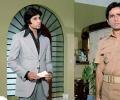
While Amitabh Bachchan's chemistry with his heroines -- from Jaya Bhaduri to Rekha to Hema Malini -- brought sizzle to his films, many of his biggest blockbusters have been powered by his combustible combination with male co-stars.

Dinesh Raheja salutes Sandhya, the acclaimed dancer who passed into the ages on October 4.

Dinesh Raheja celebrates Lata's 96th birth anniversary on September 28 by picking some choice examples of her non-typical songs that are tinged with a rare eroticism.

'Pahlaj Nihalani came to my rescue. There was no Instagram in those days so I didn't recognise him.' 'I almost fainted when he told me he was Pahlaj Nihalani, the producer of Ilzaam, the hit film that had just made Govinda a star.' 'I told him I was a model and an aspiring actor, and he responded, "You have an interesting face. Come and meet me in the office tomorrow".'

'I fell in love with Suraiya and that was my first real gafla. The more I couldn't get her, the more I wanted her. When I couldn't marry her because the world didn't want it, I cried for the first time.'

'Why don't I organise an auction of cinematic memorabilia?' recalls Dinesh Raheja. 'There are sure to be legions of film buffs who will cherish the chance to own souvenirs intimately associated with their favourite stars onscreen.'

'I make films which I think have the possibility of being liked by a majority of people, and you present it with the right emotions.'

'I played five different versions of Woh Subah Kabhie Toh Aayegi for Raj Kapoor, only to be greeted with a totally blank reaction.' 'Thereafter, for 40 minutes, he disappeared, leaving us baffled.' 'But when he emerged, he couldn't stop appreciating our efforts!' 'He said Sahir Ludhianvi's writing was sheer poetry and since all my five tunes were equally wonderful, he would leave it to my discretion to chose the final tune.' 'What could be greater appreciation for an artiste?'
